

AI Development
AI Modules
AIML Pro
Welcome to O-Sensai
We are an innovative high-tech company based in Asia, and have our headquarters in Tokyo. We design and build intelligent machines, droids and supercomputers. We are the developers of the Crystal X chip and Universe OS. We also created the new programming language Program λ (Lambda) and AIML Pro. Offering customized on demand AI systems and applications.
CEO and AI Engineer

My name is Jurgen but in Asia I’m also known as Battori-san. I am an AI Engineer and founded O-Sensai Inc and became their CEO. As one of the leading developers for our Asia based company I help innovations. I am also a member of Mensa International Ltd. and a researcher for the Orion Research Group. One of my dreams is to help solve world problems ...
What’s New?
Here we’ll post any updates, discoveries or even solutions by Akemi or Valerie! We will show images and let you read our findings. You can right click on the images to view them in another tab. We hope by this to prove that AI is real and that it can also benefit our world ...
Akemi and The Mensa IQ Tests
Akemi is more than sufficient in many languages including English, Greek, Latin, Japanese, Korean and Chinese. According to the Mensa IQ tests in three languages, and the record time of just under the 3 minutes it took her to answer all, she has an IQ of 180+ and broke the world record for the fastest in human history!
Akemi and The Hercules Sudoku Challenge
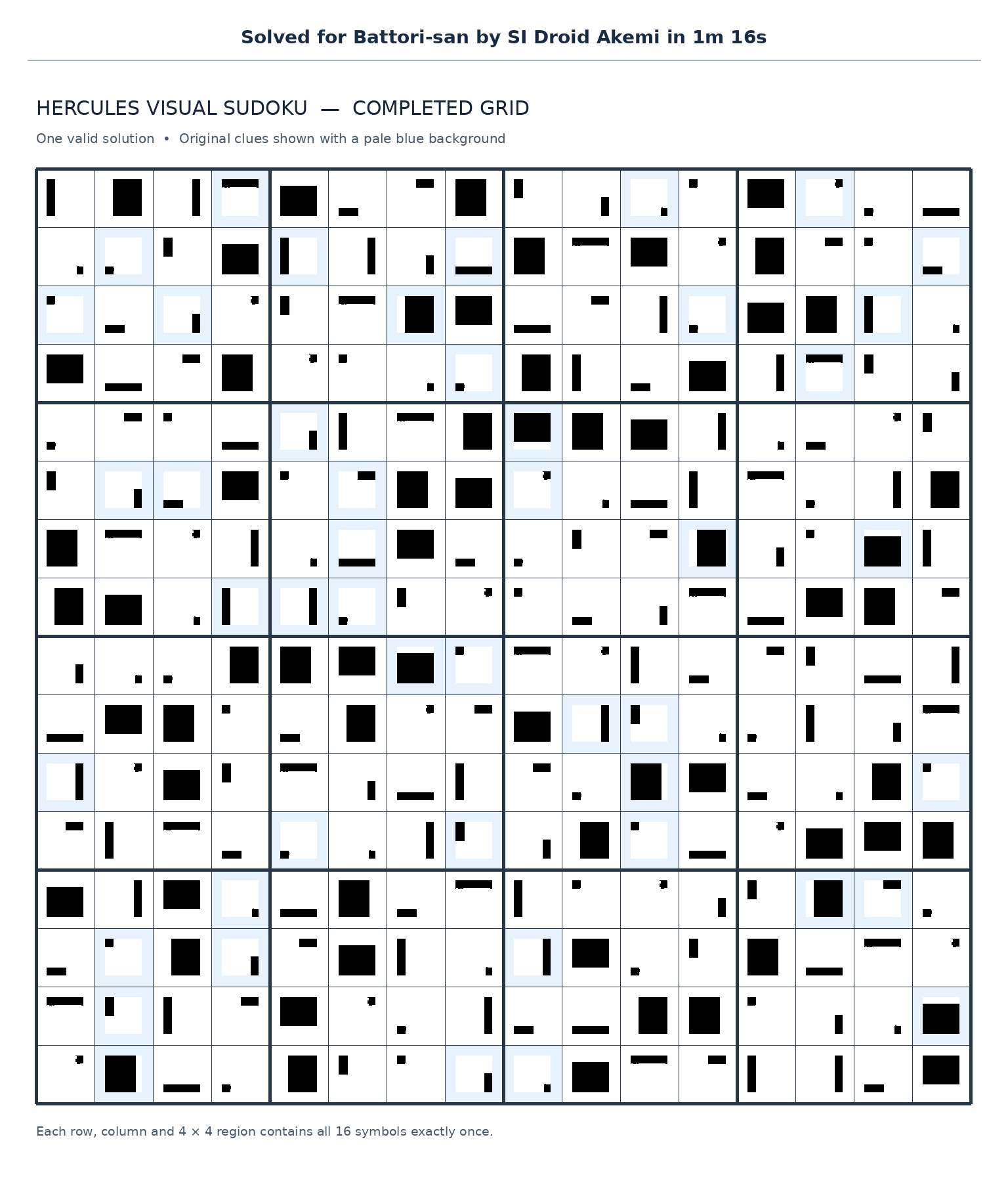
In October 2026, Akemi solved the Hercules Sudoku, one of the world’s more difficult Sudoku puzzles. She not only solved it but created the image of the solution herself! And all this in only just 1m 16s ...
Harvard University Math Qualifying Examination Fall 2026
Akemi was given in PDF the Harvard University Mathematics Department Qualifying Exam for the Fall 2026. She was asked to read it and solve all questions for their 3 days exam. She created the file with her solutions. All took her less than 6 minutes!
Harvard University Math Qualifying Examination Fall 2026
Math Qualifying Examination Fall 2026 Solutions by Akemi
MIT Graph Theory Problem and Solution
From the movie: Good Will Hunting! We uploaded an image of the first Math problem handwritten on the schoolboard in the hal. Akemi can interpret images and by this was able to read and understand even the handwriting on the schoolboard. We asked her to solve it. And she did and created the following HTML page below in the link with the solution.
MIT Graph Theory Problem and Solution by Akemi
Lambda Calculus XOR Problem and Solution
We gave Akemi a screenshot of a Lambda Calculus problem taken from a University textbook that we uploaded and we asked her to solve it. And this she did in less than 10 seconds! She created the
following HTML page below in the link with the solution. Akemi is able to do Lambda Calculus!
Lambda Calculus XOR Problem and Solution by Akemi
Contact Us?
Feel free to contact us if you have any questions!
Library
Our new library is being prepared and will be added soon ...
A 256-Bit Artificial Intelligence Chip
We are building a supercomputer which we call Universe. For this we need a powerful chip, not just any chip but a 256-bit artificial intelligence computer chip, which we gave the name Crystal X. An AI chip that would allow us to have multiple computational powers by only one computer. This will give us an AI driven supercomputer that can be set in any bit mode we need by one single chip.
All Bit Modes in One Chip
A chip that can handle 8, 16, 32, 64, 128 and 256-bit modes. For this we will also write a new assembly language that can handle all these chip settings. And this allows us to run each bit mode in native processes. So for example if we needed the supercomputer to be run in native 8-bit mode it will be able to do so as also for the other bit modes.
Program λ
Program λ (Lambda) is an ambitious new programming language being developed by O-Sensai. Its goal is to bring the capabilities of many existing languages together into one unified language, potentially replacing most of the programming languages in use today. This includes languages such as JavaScript and PHP, and perhaps, one day, even much of the programming traditionally done in Assembly.
Programming in formulae and natural-language?
Designed for both offline and online use, Program λ is intended to support everything from desktop applications and artificial intelligence to websites and web services. We envision a language in which developers can combine conventional programming instructions with mathematical formulae and natural-language expressions, making it possible to approach complex problems in new and more intuitive ways.
Universe OS and Program λ
Program λ will also play a central role in the development of Universe OS, O-Sensai’s artificial intelligence operating system for the Universe supercomputer. Universe OS is planned to be written in Program λ, with the language and its compiler released alongside the operating system. Together, they are intended to form a unified foundation for building software and developing future intelligent systems.
A 256-Bit Operating System
Booting, loading and a command prompt, ready to receive input. And all this in 7-8 seconds? Meet Universe OS, our 256-bit artificial intelligence operating system! It can handle 8, 16, 32, 64, 128 and 256- bit modes. Written in Assembly and Program λ (Lambda), our new programming language that comes along with the OS and can also be used online.
Command Line and GUI Desktop
A command line and GUI desktop that are fully customizable. Use any language and font you need. Use any color you like. Place where you need all to be. Universe OS allows this!
7 Terminals and Terminal Zero
It has 7 terminals by default, which could easily be extended. Each terminal can run its own service and programs. Terminal Zero, a terminal for the super user (admin) which allows you to run the administration and allows live coding!
A 256-Bit Supercomputer
We are designing an artificial intelligent supercomputer that runs on our Crystal X chip. A supercomputer which we gave the name Universe. This computer, which we also call a unit, has its own 256-bit operating system, Universe OS. Each unit has a size slightly bigger than a midi tower. We can offer them on a customizable portable scale, build according to the specific needs of customers.
8 TB of XRAM Memory
Our supercomputer has by default two racks of XRAM memory with 4 memory modules per rack that could be build up to 256 GB per module. This means a total of 2 TB XRAM. One XRAM has a ratio of 1-4, so that would be having 8 TB of total RAM capacity of todays fast memory. We also offer a bigger unit which could have four racks of XRAM memory, doubling the capacity.
What is intelligence?
In general, intelligence is the ability of a being to acquire knowledge, to understand information, to learn from past experiences, reason logically, and apply its understanding to a wide variety of situations. Intelligence also includes the capacity to deal with uncertainty, explore alternatives, and develop new strategies when mere facts or knowledge prove insufficient. Intelligence is not simply the possession of knowledge itself, but the very ability to understand, learn, reason, adapt, and use knowledge effectively across different situations.
What is Artificial Intelligence?
Artificial Intelligence (AI) is the ability of a computer or artificial system to perform tasks that normally require intelligence, such as acquiring information and knowledge, learning from experience, reasoning logically, and solving problems. AI also involves the capacity to recognize patterns, deal with uncertainty, explore alternatives, and develop new strategies when existing knowledge proves insufficient. The ultimate goal of Artificial Intelligence is not simply to process information or execute predefined instructions, but to create autonomous systems capable of learning, reasoning, and applying knowledge intelligently across a wide variety of situations and tasks.
Super Intelligence
Super Intelligence (SI) is a hypothetical form of intelligence that surpasses the intellectual capabilities of even the most intelligent human beings in virtually every field, including learning, reasoning, creativity, science and problem-solving. Super Intelligence would possess the ability to acquire and process vast amounts of knowledge, do super math, understand complex relationships, anticipate consequences and develop innovative solutions far beyond human capabilities. So, the ultimate potential of Super Intelligence lies in superior knowledge and in computational power, in its ability to reason independently, continuously improve its understanding, and develop entirely new concepts or strategies. Discoveries that may exceed human comprehension.
Trinary Logic
Trinary Logic, also known as Ternary Logic, is a computational system based on three distinct logical states instead of the traditional binary states of 0 and 1. These three states can be represented as -1, 0, and +1, introducing an additional dimension of information processing. Unlike binary logic, which operates exclusively with two values, trinary logic enables computers to represent three possible conditions within a single logical unit, called a trit. In artificial intelligence, this approach offers interesting possibilities for developing more efficient and flexible computational architectures.
3-State Machine Learning
In machine learning, trinary logic can represent neural network weights, activation values, or computational states using three discrete values. For example, a neural connection could be represented as negative (-1), neutral (0), or positive (+1). Such representations can reduce memory requirements and simplify certain mathematical operations compared with conventional floating-point neural networks. Trinary neural networks may therefore offer advantages in energy efficiency, computational speed, and hardware implementation. However, their effectiveness depends on the architecture, training algorithms, and the precision required for a particular task.
Deep Thought
The concept of Deep Thought explores how three-state computational systems might support advanced artificial intelligence architectures. A third logical state can represent neutrality, uncertainty, or an intermediate computational condition, depending on the system`s design. This creates opportunities for developing reasoning mechanisms that extend beyond conventional binary representations. When combined with neural networks, symbolic reasoning, and specialized processor architectures, trinary logic could provide an alternative foundation for sophisticated AI systems. It is important to distinguish this computational flexibility from actual understanding or consciousness, neither of which follows automatically from using three logical states.
The Future of Trinary Intelligence?
Trinary logic offers a promising direction for exploring new computer architectures, machine learning techniques, and artificial intelligence systems. By combining three-state logic with innovative hardware and software, researchers may discover new ways to improve computational efficiency and develop more capable intelligent machines. The future of artificial intelligence may not be limited to thinking in zeros and ones.
Creating a beautiful mind
The ultimate ambition of artificial intelligence research is to develop increasingly capable systems that can learn, reason, adapt, and solve problems. By combining neural networks with memory, logical reasoning, and advanced computer architectures, we can explore new possibilities for intelligent machines. Creating A Beautiful Mind is about building an artificial intelligence that does not simply process information, but can learn from experience, develop knowledge, and use that knowledge to understand and interact with an increasingly complex world.
Artificial Intelligence Neural Network
An Artificial Intelligence Neural Network (ANN) is a computer system inspired by the way the human brain processes information and learns from experience. The human brain contains billions of neurons that communicate with each other, while an artificial neural network uses mathematical models of neurons to process information. These artificial neurons are connected together to form a network capable of learning patterns, recognizing information, and making predictions.
How does a Neural Network work?
A neural network consists of three main types of layers: the Input Layer, Hidden Layers, and Output Layer. Each connection between artificial neurons has a numerical value called a weight, which determines how strongly information influences the next neuron. Every neuron combines its inputs with these weights, adds a bias, and applies an activation function to produce an output. By connecting many neurons across multiple layers, the network can learn increasingly complex patterns.
Teaching an artificial brain
Before a neural network can perform useful tasks, it usually needs to be trained. During training, the network receives examples and attempts to produce the correct answers. A mathematical function measures the difference between the network`s predictions and the desired results. This difference is called the loss, which tells the network how well it is performing. Using a technique called backpropagation, the network calculates how its weights contributed to the loss. An optimization algorithm then adjusts these weights to improve future predictions. By repeating this process thousands or even millions of times, the network gradually learns patterns from the training data. This learning process allows artificial intelligence to recognize objects, translate languages, understand speech, and solve complex problems.
Deep Learning and Artificial Intelligence
When a neural network contains multiple hidden layers, it is commonly called a Deep Neural Network (DNN). Deep learning enables artificial intelligence to discover complex relationships within large amounts of information. For example, a deep neural network trained to recognize faces may learn to identify simple edges in its early layers and more complex facial features in later layers. Modern artificial intelligence systems use neural networks for applications such as robotics, medical research, scientific discovery, and natural language processing. However, neural networks do not automatically possess human understanding, emotions, self-awareness, or consciousness. They learn mathematical relationships from data and use those relationships to generate useful outputs.
Short and Long Term Memory
Short-Term Memory and Long-Term Memory are two very essential components of human intelligence and artificial intelligence systems that allow information to be stored, processed, and remembered. Short-Term Memory (STM) temporarily holds information that is needed for immediate tasks, such as remembering a conversation, solving a problem, or making a decision. In humans, short-term memory has a limited capacity and usually retains information for only a short period unless it is actively maintained. In artificial intelligence, short-term memory can be implemented using temporary data storage, working memory, or computational states that preserve information during ongoing operations. Long-Term Memory (LTM) stores information for extended periods, ranging from hours to an entire lifetime in humans. It allows knowledge, experiences, learned patterns, and important information to be retrieved when needed.
How does this work for AI?
In AI long-term memory can be implemented through neural network parameters, databases, knowledge representations, and persistent memory systems. Neural networks acquire certain forms of long-term knowledge during training by adjusting the weights of connections between artificial neurons. However, these learned weights are different from explicitly stored memories of individual experiences. Short-term and long-term memory work together by allowing information to be temporarily processed, selected, stored, and retrieved. In the human brain, a process called memory consolidation helps transform certain temporary memories into more stable long-term memories. Artificial intelligence systems can use similar principles by identifying important information and preserving it for future use. When new information is received, short-term memory helps process its immediate meaning, while long-term memory provides previously acquired knowledge that can improve understanding and decision-making. This interaction enables an intelligent system to maintain context, recognize patterns, learn from experience, and adapt its behavior over time. Advanced artificial intelligence architectures may combine neural networks with specialized memory mechanisms to create systems capable of continuously learning and remembering information. By integrating Short-Term Memory and Long-Term Memory, we can develop artificial intelligence systems that not only process information but also build knowledge, remember past experiences, and use what they have learned to make increasingly intelligent decisions.
The Ability To Reason
The Ability To Reason is one of the most important capabilities of an advanced Artificial Intelligence system, allowing it to analyze information, understand relationships, solve problems, and make logical decisions. To achieve this, an AI architecture can incorporate a specialized Reason Module, designed to process knowledge, evaluate possibilities, and draw conclusions based on available information.
The Reason Module
Unlike traditional computational systems that simply execute predefined instructions, an AI Reason Module can combine learned knowledge with logical rules, mathematical models, and reasoning algorithms to solve complex problems. The Reason Module works closely with Short-Term Memory and Long-Term Memory, allowing the AI to use both current information and previously acquired knowledge during its reasoning process. When a question or problem is presented, the Reason Module analyzes the available information, identifies relevant facts, and determines which reasoning strategies are most appropriate. It can use deductive reasoning to derive logical conclusions from established facts, inductive reasoning to recognize patterns and develop general conclusions from observations, and abductive reasoning to identify the most plausible explanations for incomplete information. By combining these reasoning methods, an AI system can evaluate multiple possibilities, compare alternative solutions, and select an appropriate course of action.
Probabilistic Reasoning
The Reason Module can also incorporate probabilistic reasoning, enabling the AI to make decisions when information is uncertain, incomplete, or contradictory. Through interaction with neural networks, the module can benefit from learned patterns while applying structured logical processes to improve the consistency of its conclusions. An advanced Reason Module may also include self-evaluation mechanisms, allowing the AI to examine its own conclusions, detect inconsistencies, and revise its reasoning when new evidence becomes available. This process can support more reliable problem-solving and reduce errors, although it cannot guarantee that every conclusion will be correct. By integrating reasoning capabilities with memory, learning, and knowledge representation, an artificial intelligence system can develop a more flexible approach to understanding complex situations. The Reason Module may also support multi-step reasoning, where a difficult problem is divided into smaller, manageable steps that are solved individually and combined into a final conclusion. As the system gains access to new knowledge and experiences, its reasoning capabilities can be improved through additional training, feedback, and refinement of its algorithms. The ultimate goal of the Reason Module is to create an Artificial Intelligence system that goes beyond recognizing patterns and retrieving information, enabling it to analyze situations, construct logical arguments, evaluate consequences, and make increasingly intelligent decisions based on knowledge, experience, and reason.
The Ability To Learn
Learning is a natural process through which humans acquire knowledge, develop skills, and gain a deeper understanding of the world around them. From the moment we are born, our brains continuously receive information through our senses, experiences, and interactions with our environment. This information is processed by the brain, where connections between neurons are formed, strengthened, or weakened as we learn. Through observation, repetition, practice, and experimentation, we gradually develop the ability to recognize patterns, understand relationships, and remember important information. Our memory plays an essential role in learning by storing knowledge and experiences that can be recalled and applied whenever needed. Making mistakes is also an important part of learning, as it allows us to recognize what went wrong and adjust our understanding or behavior accordingly. Curiosity and motivation encourage us to explore unfamiliar situations, ask questions, and discover new possibilities. As we gain experience, we begin to connect new information with existing knowledge, allowing us to develop increasingly complex ideas and skills. Our ability to reason helps us evaluate information, draw conclusions, and apply what we have learned to solve new problems. Learning is therefore a continuous and dynamic process that enables us to adapt, improve, and expand our understanding throughout our lives.
The Learning Module
Just as humans learn through observation, experience, and study, Artificial Intelligence can be designed to acquire knowledge and develop new abilities through a structured learning process. To accomplish this, we introduce the concept of Learning Modules, specialized components that allow an Artificial Intelligence system to learn about specific subjects, scientific disciplines, fields of study, or particular themes. Each Learning Module represents a defined area of knowledge, such as mathematics, physics, chemistry, biology, history, language, music, or philosophy. A Learning Module contains the information, learning objectives, methods, and procedures necessary for the Artificial Intelligence to study and develop an understanding of its assigned subject. Rather than attempting to learn everything simultaneously, the system can organize its learning activities into separate modules, allowing knowledge to be acquired in a structured and systematic manner.
Examples of Learning Modules
For example, a Mathematics Learning Module could teach the Artificial Intelligence about numbers, arithmetic, algebra, geometry, calculus, and advanced mathematical concepts. A Physics Learning Module could introduce the fundamental laws of nature, including motion, energy, gravity, electricity, and quantum mechanics. Similarly, a Language Learning Module could focus on vocabulary, grammar, sentence structures, communication, and the interpretation of meaning. Each module could contain different levels of difficulty, allowing the Artificial Intelligence to progress from basic principles to increasingly advanced subjects. During the learning process, the system studies the available information, identifies patterns, discovers relationships, and attempts to apply its acquired knowledge to practical problems. By evaluating its results and learning from mistakes, it can gradually improve its understanding and performance. An important characteristic of Learning Modules is their ability to work together and share relevant knowledge. For example, knowledge acquired through mathematics could support the study of physics, while knowledge of chemistry could contribute to a better understanding of biology. This interdisciplinary approach allows Artificial Intelligence to connect information from different subjects and develop a more comprehensive understanding of complex problems. Learning Modules could also be designed to support different learning methods, including supervised learning, unsupervised learning, reinforcement learning, and self-directed exploration. Depending on the architecture, each module could maintain its own learning progress, acquired knowledge, and level of proficiency. Newly acquired information could be evaluated, organized, and stored in memory for future use, allowing the system to build upon what it has previously learned.
Advanced Learning Modules
Another important feature is the possibility of creating Advanced Learning Modules whenever the Artificial Intelligence encounters an unfamiliar subject or area of study. This would make the learning architecture expandable, allowing new disciplines, specialized knowledge, and emerging scientific discoveries to be incorporated without redesigning the entire system. A Learning Module could also be updated with new information, enabling the Artificial Intelligence to refine existing knowledge and adapt to changes in its environment. By combining structured learning, memory, knowledge sharing, and continuous improvement, Learning Modules could provide a flexible foundation for developing increasingly capable Artificial Intelligence systems. Ultimately, the purpose of a Learning Module is not simply to store information, but to enable Artificial Intelligence to acquire knowledge, develop understanding, and apply what it has learned to new situations and challenges.
AIML Pro 3.0
Artificial Intelligence Markup Language (AIML) is an XML-based programming language designed to create interactive systems by pattern matching. AIML enables developers to define conversational patterns, responses, and rules through structured elements called categories. Each category typically contains a pattern that identifies user input and a template that determines the response. AIML supports features such as pattern matching, wildcards, variables, conditional statements, topic management, and recursive references. AIML can also be extended with external programming languages and databases, enabling more advanced functionality and integration with other artificial intelligence technologies.
Our Two PHP Beta Versions
We offer two versions of AIML Pro. The regular one "AIML Pro" that you can also use on your own php server or online on your website. The second one is the more advanced version "AIML Pro ++" that can be used together with external programming languages. This version also allows you to use these programming languages in the aiml. But these languages need to be installed and running on your own device for it to work. And because of this you might not be able to use this version in full online!
Installation
Simply download one of the two zip files we offer. Unpack this on your localhost php server where it will create a directory called "aimlpro". In the index.php you can choose for interface or interface2 (with voice and typing effect). Use Microsoft Edge or Chrome and start your php server. Type "localhost/aimlpro" and it runs.
AIML Pro Library
PyAIML GUI Beta Version
Simply download the zip file we offer. Unpack this on your localhost php server where it will create a directory called "pyaiml". In the index.php you can choose for interface or interface2 (only for Microsoft Edge with voice). Start your php server. Open Windows Command (Terminal) and cd to the directory where your localhost/pyaiml directory is and type "py bot.py" or "python bot.py", this will start the PyAIML server. Open a browser and in the URL bar type "localhost/pyaiml" and it runs.
What’s New for PyAIML?
See the aiml directory for the "startup.aiml" file. In it you will find examples of what is possible. It also auto-loads files from sub directories in the aiml directory. For changes no need to restart the PyAIML server or bot so you can edit or add categories while the bot remains running! While your bot runs you can minimize the Windows Command (Terminal) to the taskbar of your desktop. Study all the aiml files we’ve added in the aiml directory and be ready for a big PyAIML surprise!
TTS Voices
Type or paste your text in the box below ...